
Hyperscalers are now committing more money than ever before to government relations. Traditionally, these efforts have been focused on power procurement, tax incentives, and zoning costs. A transition is now occurring right before our very eyes. Water is rapidly becoming just as critical—both as a cost driver and a source of added value.
Water sourcing, treatment, and disposal materially impacts CAPEX and total operating cost. The business landscape looks markedly different than it did even one short year ago. A year ago, local officials expected clear projections of peak water demand and commitments for long-term availability due to the added infrastructure strain—not just for the impacts of the data center campus, but for the anticipated growth of the community, taking into account deterioration and maintenance. That was last year’s news.
Today, officials want more. A lot more. And as a sign of the current zeitgeist, hyperscalers all to happy to relent. Mission Critical Facilities (MCFs) are simply that important. What are the new demands? MCFs need water, and a lot of it. Hyperscalers are now building brand new water treatment plants for communities in exchange for sweetheart deals on water use. But there are a few catches: water footprint (exercising good water stewardship), aerosolized pathogenic concerns from refugee cooling tower mist, and the time-honored NIMBY complaints, so who’s winning?
It depends. And government relations is at the heart of doing it right. For all my attorney friends, this is your chance to be on the right side of history by leaving your mark on an even-keeled approach for progress—an approach where everyone wins.
Where are the cost drivers? Projects that rely heavily on potable water can face higher permitting hurdles, infrastructure fees, or outright delays, while those that incorporate reclaimed or recycled supplies may reduce costs and gain faster approvals. In many jurisdictions, using non-potable water isn’t just an environmental win—it can translate into rate advantages, lower impact fees, and improved community alignment.
Discharge quality and wastewater handling also carry cost implications. Stricter standards can require additional treatment systems, raising capital and operating expenses. However, facilities that invest early in high-quality discharge solutions may avoid future retrofits, reduce regulatory risk, and strengthen partnerships with municipalities.
Public-health considerations in cooling systems—particularly around aerosolized pathogens—add another layer of financial exposure. Compliance with evolving health regulations can increase upfront design costs, but it also mitigates liability, protects uptime, and reinforces trust with local stakeholders.
The annual cost of running an effective government relations depends on the size of the company, but for the medium-sized hyperscaler, the cost can easily be in the millions. Is it worth it?
That’s a resounding yes!
Better relations with community stakeholders, job creation, advocacy for clean water, water stewardship, ESG, streamlined permitting, progress for humanity, progress for computing power, stronger communities, stronger infrastructure… the list goes on.
Ultimately, water strategy is no longer just a compliance issue—it is a lever for cost optimization and long-term value creation. Data center operators that proactively address water sourcing, efficiency, and health safeguards can unlock incentives, reduce risk, and position themselves as preferred partners in increasingly resource-constrained communities.
References:
Duffy, K. (2026). America’s digital empire has a trust problem. Council on Foreign Relations. America’s Digital Empire Has a Trust Problem | Council on Foreign Relations
Goetzel, D., Muro, M., and Methkupally, S. (2026). Turning the data center boom into long-term, local prosperity. Brookings Institute. Turning the data center boom into long-term, local prosperity | Brookings
Kumar, S. and Shah, P. (2025). Digital ESG as a catalyst for achieving the sustainable development goals: a bibliometric analysis of digital transformation for a resilient future. Sustainable Futures, 10, 101458, ISSN 2666-1888, https://doi.org/10.1016/j.sftr.2025.101458
Murino, T., et al. (2023). Data center sustainability and resource management. Journal of Cleaner Production. https://doi.org/10.3390/en16155764
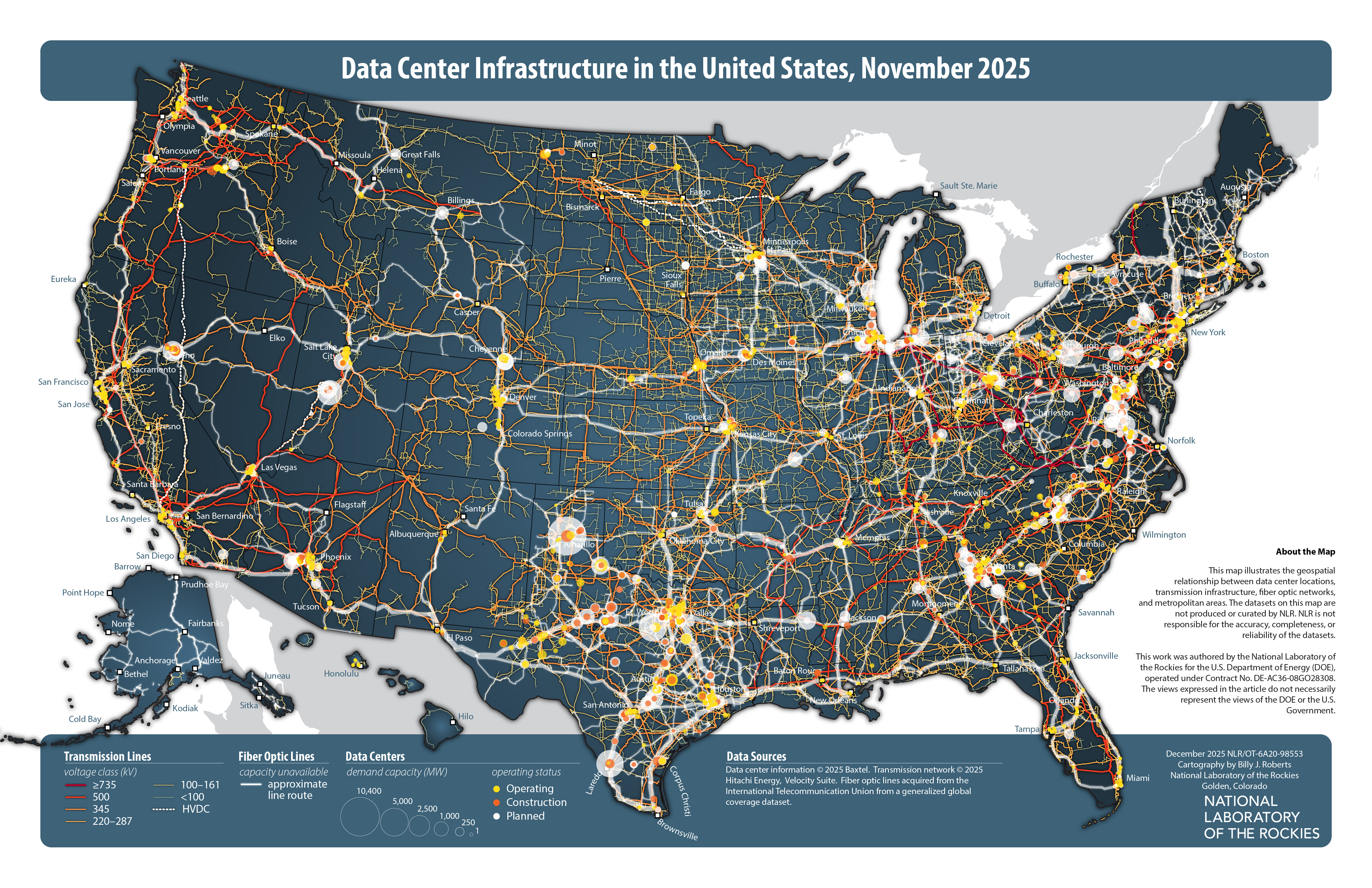
National Laboratory of the Rockies. (2025). Data center infrastructure in the United States, November 2025. docs.nlr.gov/docs/gen/fy26/98553.jpg
Patel, S. C. (2026). Hyperscalers sign White House pledge to fund data center power, grid upgrades. Power. Hyperscalers Sign White House Pledge to Fund Data Center Power, Grid Upgrades
Siddik, M. A. B., Shehabi, A., & Marston, L. (2021). The environmental footprint of data centers in the United States. Environmental Research Letters, 16(6), 064017. https://doi.org/10.1088/1748-9326/abfba1
Thompson, D., Lenoir, T., and Liu, P. (2026). Geopolitics of data centers: an AI showdown that will reshape the world. S&P Global. Geopolitics of data centers: An AI showdown that will reshape the world | S&P Global
UNESCO. (2024). The United Nations world water development report 2024: Water for prosperity and peace. UNESCO. https://www.unwater.org/publications/un-world-water-development-report-2024